
Toledo, OH and Northwest Ohio
Composite Decking in Toledo, OH
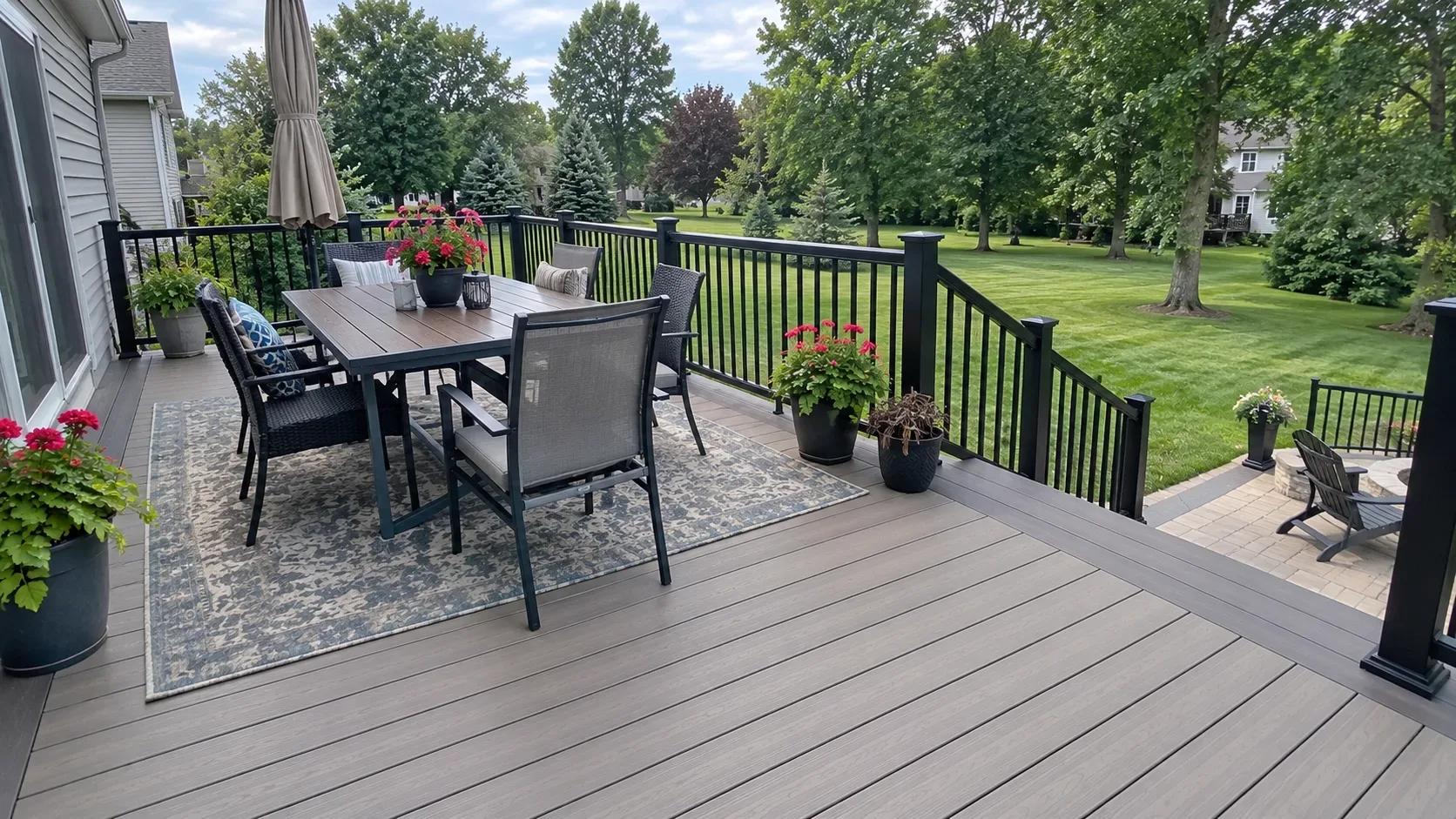
Capped composite and PVC decking fitted over a frame built for it. No sealing, no staining, and a surface that is still the same colour in ten years.
- Footings built for this frost line
- Permits and inspections handled
- Written scope before we start
Toledo Custom Decks fits capped composite and PVC decking throughout Toledo and Northwest Ohio, on frames built to whatever centres the chosen board actually specifies rather than whatever spacing happened to be used on the last job.
The problem composite actually solves is not usually a deck that failed. It is a deck that greyed out and needed sanding every other spring until one year that job simply never got done.
Northwest Ohio winters make the case for composite even stronger. A capped board will not take on the moisture that makes a timber board swell, split and eventually cup through repeated freeze and thaw, and there is no fresh coat to apply before the next cold season sets in. Get the frame underneath right once, and the surface stops being something you have to think about at all.
The brands we actually fit
Trex
Homeowners ask about Trex before any other name. Enhance covers the budget end competently, while Transcend and the Lineage colours step up to richer tones and a formulation built to run cooler in summer heat. Every line is made from wood flour and capped on three or four sides, depending which one you choose.
We tend to reach for Trex most often simply because local suppliers carry it in the deepest stock, which turns out to matter years later if a board needs replacing and has to match one that has already spent a decade fading gently in the sun.
TimberTech and Azek
TimberTech’s composite lines sit in roughly the same price and performance bracket as Trex. Azek is where the company actually differentiates itself: a capped PVC with no wood content whatsoever. Nothing organic means nothing for mould to feed on, and the boards are noticeably lighter to handle and cut. It is also the most expensive material we install and carries the longest warranty we can offer.
That lack of wood content means Azek moves the least with temperature of anything on this page, which shows up as tighter, more consistent gaps across a long run of decking on a hot afternoon.
Fiberon
Concordia and Good Life are the two Fiberon lines we reach for most. What sets them apart is how convincingly the darker, multi tonal boards mimic real timber grain, well beyond what an entry level board from another brand manages. On an older property where a flat grey would look wrong, Fiberon is usually the first sample we hold up against the house.
It also suits a homeowner who likes the look of tropical hardwood next door but has no interest in the fastening labour or the yearly oiling a genuine hardwood deck demands.
Deckorators
Deckorators is built from minerals rather than wood flour, which sets it apart from everything else on this list. It shrugs off water, holds its dimensions where other composites expand and contract seasonally, and runs cooler underfoot than you would expect. It is also the one line where choosing a dark colour for a south facing Toledo deck is a defensible decision rather than a regret by the second week of July.
The trade off is weight. Mineral based boards take more effort to carry and set, which adds a little time to an install day, though it makes no difference to how the finished deck performs.
What actually happens during the install
The frame matches the board, not the crew’s habits
Before a single board goes down, we measure the joist centres against the manufacturer’s own specification rather than whatever spacing the last job happened to use. Straight runs generally want sixteen inches on centre, diagonal runs want twelve, and stair treads want twelve regardless of the field pattern. A frame already sitting at 24 inches gets sistered joists added, or we tell you plainly it needs rebuilding.
This single check is the difference between a composite deck that stays flat for fifty years and one that starts bouncing by its first winter, and confirming it costs minutes against years of regret.
Butyl tape, every joist, every beam
Every framing member gets a run of butyl tape along its top edge before anything is fastened through it. The tape seals around each screw penetration and keeps water out of the hole beneath. Once a fifty year surface sits on top, the frame quietly becomes the weakest link in the whole build, and taping it is the cheapest decade of extra life you can buy for that frame.
Skip it and you save perhaps an hour on an average job. Ten or fifteen years later that shows up as a soft joist hiding under a surface that still looks brand new, which is a bad trade under any accounting.
Fasteners you cannot see
Grooved boards take a clip system that keeps a consistent gap and leaves no screw heads visible in the field. Driving screws straight through the face is faster, and it looks like it, which is the whole problem with taking that shortcut. Where the system calls for it, perimeter boards and stair treads get face fastened with screws colour matched to the board.
Gaps set from the day’s actual temperature
Composite expands and contracts with heat, so the end gap between boards comes straight off the manufacturer’s chart for whatever temperature it is on install day. A deck fitted on a cold February morning needs a different gap than one fitted in August. Set the boards tight on a cold day here and they will buckle once summer arrives.
We log the board temperature at the start of every install for exactly this reason, because guessing at the gap is how a deck that looks flawless in April develops a visible ridge by July.
Picture framing and fascia, decided early
A border board around the perimeter hides the cut ends of the field boards, which is usually the moment a composite deck stops reading as a covered surface and starts reading as finished. Fascia closes off the rim beneath it. Both need blocking built into the frame, so the decision has to happen before framing starts, not once the joists are already down.
A contrasting picture frame also hides small cutting imperfections at the edge, which is a large part of why it is the upgrade homeowners request most once they see a sample panel put together.
How composite stacks up against the alternatives
Versus pressure treated
Treated pine costs roughly half as much installed, then asks for a wash and reseal every two or three years to keep looking presentable, and it will still check and splinter with age no matter how well it is maintained. Composite front loads the cost and asks almost nothing afterward. At current Toledo pricing, the two typically break even somewhere around year ten to twelve of ownership.
Versus cedar
Cedar wins the first summer outright, and most people genuinely prefer the feel of real grain underfoot. It is also softer, it dents under furniture legs, it greys within a season if left unsealed, and it costs more than pressure treated pine to begin with. Composite is the long game, cedar is the first impression, and on an older home near a historic streetscape like Waterville, cedar sometimes wins the argument outright because a composite board would sit oddly against the house.
Versus capped PVC
PVC is lighter, cooler underfoot, fully waterproof, and comes with the longest warranty of anything we install. It also costs the most, and up close some homeowners find the surface reads slightly less like real wood than a good composite board does. Beside a pool, on a rooftop deck, or anywhere water genuinely sits for extended periods, PVC earns the extra cost outright.
Where the money in a composite quote actually goes
The board is a smaller slice than people assume
Roughly a third of what you pay installed is the decking material itself. The rest covers the frame, the footings, the railings, the stairs and the labour, none of which gets cheaper just because you picked a nicer surface.
That is why stepping up from entry level composite to a mid tier product rarely moves the total as much as homeowners expect, while adding a second stair run or a taller railing tends to move it more than they anticipated.
Footing depth is fixed regardless of what decking sits on top, since a hole dug to the Northwest Ohio frost line does not get shallower because the boards cost less. If two quotes for the same deck come back far apart, ask both builders what footing depth each one is actually pricing before assuming the cheaper number is the better deal.
Railings move the number more than boards do
An aluminium railing system typically runs $82 to $133 per linear foot installed, so a deck with a long perimeter can carry nearly as much cost in railing as in decking. Where a deck sits under 30 inches off the ground we often drop the railing requirement entirely, which is a real saving rather than a rounding error on the final number.
Keeping it looking new, honestly
Wash it twice a year and that is most of the job
A composite cleaner and a soft brush, once in spring and again before autumn leaf fall gets serious, covers most of what keeps a composite deck looking new through its warranty period.
Spring pollen and summer tree sap are what homeowners notice most, and both come off easily with a soft brush while still fresh, long before they have had a chance to bake into the cap under a full day of sun.
Getting ready for winter
Clear the gaps between boards before winter sets in, since wet leaf litter trapped there is what causes staining and surface growth. Keep a pressure washer well back from the cap, and use a plastic shovel rather than a metal one when clearing snow. That covers the entire list. Nothing about a composite deck ever needs sanding, sealing or staining.
Where we fit composite decks
We install composite decking across Toledo, Ottawa Hills, Perrysburg and Waterville. Around Perrysburg’s newer construction, composite is essentially the default: a consistent, low upkeep surface that matches the scale of the larger, more recently built homes spreading out there. It works just as well on Ottawa Hills’ established lots, where a carefully chosen colour reads as a deliberate decision against an architecturally significant older house rather than an afterthought.
Close to Waterville’s historic core, a quieter, more restrained tone generally suits the streetscape best, while newer lots further out give a bolder colour more room to work without fighting anything nearby. Whichever colour gets chosen, the frame underneath is built to the same standard every time, and that is the part nobody ever sees once the boards are down.
Deck cost in Toledo, OH
Why homeowners pick Toledo Custom Decks
Footings built for this frost line
Northwest Ohio sits deep enough in the Lake Erie snowbelt that local jurisdictions generally call for footings well past 32 inches, deeper than central or southern Ohio requires. Every post we set lands on a poured footing sized to the depth your jurisdiction sets, which is what keeps a deck level through a decade of freeze and thaw.
Permits and inspections handled
We work out which department your address answers to, whether that is the City of Toledo, a suburb running its own building office, or Lucas or Wood County, pull the permit, meet the inspector and hand you the signed card. An unpermitted deck becomes your problem the day you sell the house.
Written scope before we start
Materials, framing spec, hardware, timeline and price in writing before anybody swings a hammer. No verbal change orders.
Composite Decking questions we get asked
Is composite decking worth the extra over pressure treated?
On a twenty year view in this climate, usually yes. A treated deck wants cleaning and resealing every two to three years, and that is a real recurring bill most homeowners plan to keep up with and then quietly do not. Composite costs roughly 60 to 90 percent more once and then asks for a wash down twice a year. If you expect to move inside five years the arithmetic is genuinely less clear, and we will say so plainly rather than push the upgrade regardless.
Does composite decking get hot in the sun?
Yes, and the colour matters more than the brand. A dark board on a south or west facing deck in July gets hot enough to be uncomfortable barefoot. Lighter greys and tans run noticeably cooler. The Deckorators mineral based boards and the TimberTech Azek PVC lines are engineered to stay cooler than standard composite. On the open, newer lots around Perrysburg this is the decision homeowners most often wish they had taken differently, so we raise it before a colour is chosen rather than after the first hot week.
What joist spacing does composite need?
Most capped composite wants joists at 16 inches on centre for a perpendicular layout and 12 inches for a 45 degree diagonal. Some products, and every stair tread, want 12 inches regardless of pattern. Framing at 24 inches and laying composite straight over it gives you a deck that bounces underfoot and a void board warranty, and it remains the most common fault we find on a deck somebody else built before us.
Can composite go over my existing frame?
Sometimes, and we get underneath before answering either way. We check joist spacing, joist condition, beam sizing, post bases and the ledger connection. A frame built at 24 inch spacing needs joists sistered in, and a nailed ledger needs correcting before anything new goes on top of it. Putting a fifty year surface on a frame with eight years left in it wastes money, and that is worth hearing plainly before you order a single board.
Does composite grow mould?
It can, on the shaded underside and in the gaps between boards, and a damp Northwest Ohio spring is exactly the condition for it. It is surface growth feeding on organic debris rather than rot inside the board itself. A wash with a composite cleaner twice a year handles it. Leaving wet leaf litter sitting in the gaps over winter causes the worst of it, so clearing them before the first snow is worth the ten minutes it takes.
If a board fades or fails, does the warranty actually cover replacing it?
Two warranties are in play and manufacturers treat them separately, so read both before deciding anything. The material warranty covers the board itself, and on some brands it is prorated after the first several years, so a claim in year fifteen can return only a fraction of a board rather than a full replacement. Labour to remove a failed board and fit a new one is a separate line that many manufacturers exclude unless the installation was registered at the time of the original build. We register every composite warranty in your name at handover and hand you the paperwork, so a future claim is already on file rather than something you have to reconstruct years later.